Python
Python est un langage de programmation interprété, généraliste et open-source, créé par Guido van Rossum en 1991. Sa philosophie : un code lisible, simple et expressif.
Caractéristiques principales
- Syntaxe claire : lisible comme du pseudo-code
- Typage dynamique mais optionnellement typé (type hints)
- Multi-paradigme : impératif, orienté objet, fonctionnel
- Garbage collector intégré
- Interprété : pas de compilation nécessaire
- Multiplateforme : Windows, Linux, macOS
Synthaxe rapide
# Variables (pas de déclaration de type)
nom = "Python"
version = 3.12

# Condition
if version >= 3:
    print("Version moderne")

# Fonction
def saluer(nom: str) -> str:
    return f"Bonjour, {nom} !"

print(saluer("monde"))

# Listes, dicts, sets, tuples
fruits = ["pomme", "banane", "cerise"]
config = {"host": "localhost", "port": 8080}

# Boucle
for fruit in fruits:
    print(fruit)

# Compréhension de liste
carres = [x**2 for x in range(10)]
Usages principaux
| Domaine | Outils / Frameworks |
|---|---|
| Web | Django, FastAPI, Flask |
| Data Science | Pandas, NumPy, Matplotlib |
| Machine Learning | PyTorch, TensorFlow, Scikit-learn |
| IA / LLM | LangChain, Transformers, OpenAI SDK |
| Automatisation | Selenium, Playwright, scripts |
| DevOps / Cloud | Ansible, Terraform (SDK), AWS Boto3 |
| Cybersécurité | Scapy, pwntools, Metasploit modules |
| IoT | MicroPython, CircuitPython |
Concepts clés
Classes & OOP
class Animal:
    def __init__(self, nom: str):
        self.nom = nom

    def parler(self) -> str:
        return f"{self.nom} fait un bruit"

class Chien(Animal):
    def parler(self) -> str:
        return f"{self.nom} aboie !"

chien = Chien("Rex")
print(chien.parler())  # Rex aboie !
Décorateur
def log(func):
    def wrapper(*args, **kwargs):
        print(f"Appel de {func.__name__}")
        return func(*args, **kwargs)
    return wrapper

@log
def addition(a, b):
    return a + b
Générateurs
def fibonacci():
    a, b = 0, 1
    while True:
        yield a
        a, b = b, a + b

gen = fibonacci()
print([next(gen) for _ in range(8)])
# [0, 1, 1, 2, 3, 5, 8, 13]
Async / Await
import asyncio

async def fetch_data(url: str):
    await asyncio.sleep(1)  # simulation requête
    return f"Données de {url}"

async def main():
    result = await fetch_data("https://api.example.com")
    print(result)

asyncio.run(main())
Écosystème & outils
| Outil | Rôle | Outil | Rôle |
|---|---|---|---|
| pip | Gestionnaire de paquets | pytest | Tests |
| venv / virtualenv | Environnements virtuels | mypy | Vérification de types statique |
| Poetry | Gestion deps + packaging moderne | ruff / black | Linting & formatage |
| pyenv | Gestion des versions Python | Jupyter | Notebooks interactifs |
Versions
| Version | Statut |
|---|---|
| Python 2.x | EOL depuis 2020 |
| Python 3.10 | Match/case (pattern matching) |
| Python 3.11 | +60% de performances |
| Python 3.12 | Actuelle stable |
| Python 3.13 | Free-threaded (GIL optionnel) |
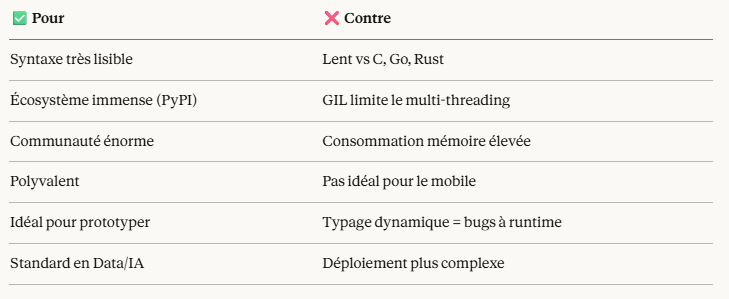
Avantages & Inconvénients
Python vs autres langages
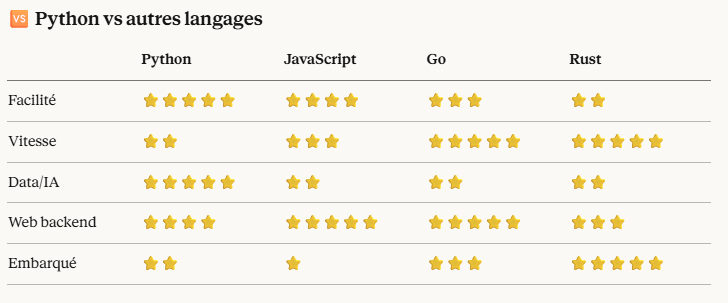
En résumé : Python est le langage le plus polyvalent aujourd’hui, incontournable en Data Science et IA, très solide en web backend, et parfait pour automatiser ou prototyper rapidement.

